Tars Tarkas and Sola
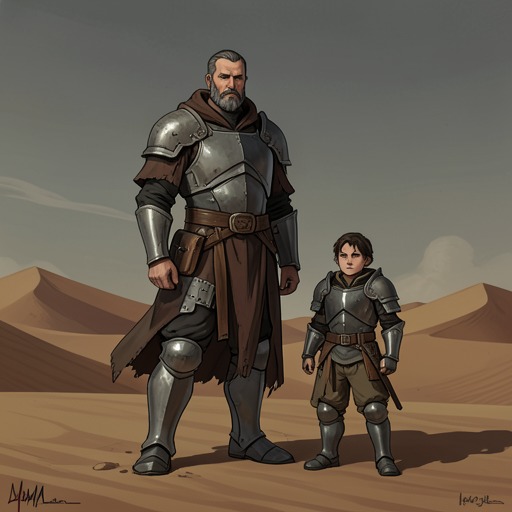
A Princess of MarsTars Tarkas and Sola are father and daughter whose relationship survives for decades as a secret within Thark society. Their story exposes the divide between the community’s collective system of child-rearing and the private attachments its customs suppress: Sola knows her father’s identity, while Tars Tarkas does not know that the daughter he has lived beside is his own. After John Carter tells him what happened to Sola’s mother, Tars Tarkas acknowledges Sola before the Thark chiefs, making their long-hidden kinship public as the Tharks and Helium establish peace.
Identity and Hidden Kinship
Sola’s parentage begins with a relationship that defies the norms of the Tharks. Her mother, Gozava, was considered too small to be entrusted with maternity under a system that selected for physical size. She was also less cruel than other Thark women and often left the deserted avenues of Thark to sit among the wild flowers on the nearby hills. There she met Tars Tarkas, then a young warrior assigned to guard the feeding thoats and zitidars. Their meetings, at first about ordinary matters, became deliberate; they came to share their hopes and their revulsion at Thark cruelty.
The relationship remained secret for six years. Gozava belonged to the retinue of Tal Hajus, while Tars Tarkas was only a warrior, and their defiance of Thark traditions risked punishment before the assembled community. Sola was born from this hidden bond, but the society into which she entered did not recognize biological parenthood as the basis of family life. Her identity as Tars Tarkas’s daughter therefore existed first as knowledge held by Sola, not as a publicly acknowledged relationship.
A Childhood Shaped by Communal Custom
The Tharks’ child-rearing system separated offspring from their biological parents. Children emerged from eggs after five years of incubation, and the females or older children who caught them as they left the incubator became their foster guardians. These guardians taught the young to speak and use weapons; parental identity and affection were not part of the system. Each adult female produced about thirteen eggs a year, but a council of twenty chiefs selected only about one hundred of the most perfect eggs from each yearly supply. After five years of selection, the chosen eggs spent another five years in incubators before hatching.
Gozava’s last sight of Sola came when she secretly joined a returning caravan carrying young Tharks. In the confusion at the plaza, she placed her child among the other children, knowing she would not hold her again. The next day the children were assigned to the retinues of the chiefs. Gozava was imprisoned by Tal Hajus, who sought the name of the child’s father. She endured punishment without revealing Tars Tarkas’s identity and died without seeing Sola again. She told her captors that she had killed the child, a claim that helped conceal Sola’s survival and parentage.
Sarkoja alone disbelieved Gozava’s account and suspected Sola’s origins. Sola later explains that only she, Tal Hajus, and Sarkoja know that Sarkoja had carried the story to Tal Hajus, setting in motion the persecution that ended in Gozava’s death. The family secret is therefore entangled with a second secret: the identity of the person who betrayed Gozava, and the danger that disclosure could bring within Thark society.
The Secret Reaches Tars Tarkas
Sola tells John Carter the history of her parents and names Tars Tarkas as her father. She trusts Carter with the information without placing conditions on what he may do with it, leaving him free to speak if the truth might help Sola, Tars Tarkas, Dejah Thoris, or himself. The confidence turns Sola’s private knowledge into a possible instrument of action, while preserving her judgment about when disclosure would be useful.
Later, when Tars Tarkas and Carter return to Thark, Carter recounts Sola’s story to him. Tars Tarkas says little, but his face shows the force of his grief and anger as he learns what happened to the only person he had loved. He then agrees to appear before Tal Hajus rather than sacrifice himself or avoid the confrontation. Before going to Tal Hajus, he confronts Sarkoja with her role in Gozava’s fate. He does not kill her, but warns that she may be subjected to a test of survival and urges her to leave on the pilgrimage to the River Iss.
The disclosure changes Tars Tarkas’s relationship to both the past and the present. The old injury is no longer only a private memory of Gozava’s death: he now knows that Sola, the woman beside him, is the child Gozava saved from the Tharks’ system. The knowledge also gives him a reason to act against the people and customs that destroyed his family, even though the account does not make his earlier ignorance disappear or suggest that he and Sola had previously lived as father and daughter.
Public Acknowledgment and Political Aftermath
The relationship reaches public recognition after the Tharks and their allies have spent ten days feasting in Helium. They set out for home with costly presents, escorted by ten thousand Helium soldiers commanded by Mors Kajak. A Helium noble accompanies them to Thark to strengthen the new bonds of peace and friendship. Sola goes with her father, Tars Tarkas, who acknowledges her as his daughter before all his chiefs.
Three weeks later, Mors Kajak and his officers return with Tars Tarkas and Sola aboard a battleship sent to bring them back for the ceremony joining John Carter and Dejah Thoris. Sola’s presence alongside her father carries the private reconciliation into the political aftermath of the conflict: their kinship is no longer merely a secret known to a few, but a relationship publicly recognized in the company of Thark leaders and Helium’s representatives.
Significance of the Relationship
The contrast between Thark custom and the bond between Tars Tarkas, Gozava, and Sola gives their relationship its central significance. Thark children are treated as communal offspring, selected and assigned to foster guardians without regard for biological parentage; Gozava and Tars Tarkas nevertheless form a lasting attachment, and Gozava’s loyalty to their child shapes her final choices. Sola carries that attachment forward by preserving the truth of her origins, while Tars Tarkas’s response shows the cost of having been kept from them.
Their story does not erase the years of separation or restore the family life that Thark society denied them. Its resolution is narrower and more concrete: the father learns the truth, confronts one of those responsible for Gozava’s fate, and publicly claims Sola as his daughter. In the wider movement toward peace between the Tharks and Helium, that act makes a suppressed personal bond visible within a changing political order.